

When your knee hurts with every step, it can feel as though your whole life has slowed down around it. Stairs become obstacles, walks get shorter, and sleep is often interrupted. If you live in Flint or the surrounding area and are considering knee reconstruction, knowing what lies ahead can ease much of the worry. Here is what to expect before, during, and after adult knee reconstruction.
Understanding Adult Knee Reconstruction
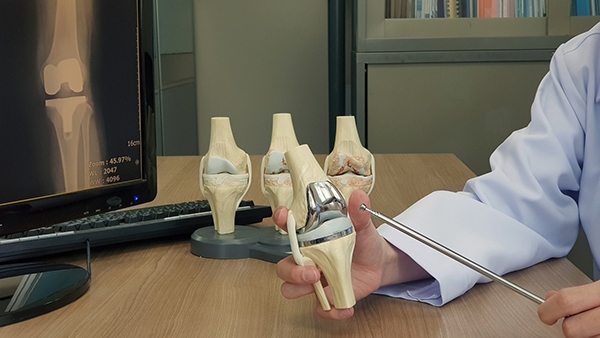
Adult knee reconstruction refers to surgical procedures that restore a knee damaged by arthritis, deformity, or a previous surgery that did not hold up over time. The most common is total knee replacement, in which the damaged cartilage and bone surfaces are removed and replaced with metal and plastic components that recreate the joint surface.2 Partial knee replacement and revision knee replacement are also part of this field.
When you see us, your care is guided by a board certified orthopedic surgeon who is fellowship trained in adult hip and knee reconstruction and experienced with Mako robotic arm assisted procedures.
Before Surgery in Flint: Evaluation and Planning
Your Consultation
Your journey begins with a detailed conversation about your symptoms and goals, a physical exam, and imaging. Knee arthritis is a frequent reason for reconstruction, and it often causes pain, swelling, stiffness, and a feeling of weakness or buckling.1 Surgery is usually considered after nonsurgical treatments no longer provide adequate relief.1,2
Choosing the Right Procedure
Depending on how much of the knee is affected, you and your care team may discuss several options:
- Total knee replacement, which resurfaces the entire joint
- Mako robotic arm assisted knee replacement, which uses a CT based 3D model of your knee to help plan implant size and placement
- Outpatient total knee replacement for appropriate patients who may go home the same day
- Complex and revision knee replacement for a knee replacement that has become painful or has failed
Getting Ready at Home
Preparation helps your recovery start on the right foot. Our surgery preparation guide walks you through the steps before your procedure. Many people also find it helpful to arrange help at home, clear walkways, and set up a comfortable space for the first days of recovery.2
On the Day of Surgery
On surgery day, the care team reviews your health, answers your questions, and discusses anesthesia with you. During a total knee replacement, the damaged surfaces of the thighbone and shinbone are removed, metal components are fitted, and a plastic spacer is inserted to allow smooth movement. The kneecap may also be resurfaced.2 When Mako technology is used, the robotic system assists with bone preparation and implant positioning according to your personalized plan.
Recovery After Knee Reconstruction
The First Days
Most people begin moving and walking with support soon after surgery, because early movement is an important part of healing.2 Pain management, swelling control, and simple exercises are focused on during this stage. Our post operative instructions explain wound care, activity, and the warning signs that should prompt a call to our office.
The Weeks That Follow
Physical therapy plays a central role in regaining strength and range of motion. Progress varies from person to person, and your commitment to your exercises at home has a strong influence on how quickly you return to daily activities.2 Over time, many patients find that pain eases significantly and that walking and stairs become easier.
Long Term Outlook
Knee replacements are designed to last for many years, and staying active within recommended limits helps protect your new joint.2 Follow up visits allow your care team to check your progress.
FAQs
How long does it take to recover from knee replacement?
Recovery is gradual and varies for each person, with most people walking with support soon after surgery and continuing to improve over the following months. Regular physical therapy and home exercises help you progress.
Will you be awake during knee reconstruction surgery?
That depends on the type of anesthesia chosen for you. Your anesthesia team reviews the options and explains what to expect before surgery.
Where can you have knee reconstruction surgery near Flint, MI?
You can be evaluated at our OrthoMichigan Flint office on W. Bristol Road or our Fenton office on Silver Parkway. We help you decide on the right procedure and setting for your surgery.
What does robotic arm assisted knee replacement do differently?
It uses a CT based 3D model of your knee to plan implant size and position before surgery. During the operation, the system assists with bone preparation and implant placement according to that plan.
Can you go home the same day after knee replacement?
Some patients who meet certain health criteria can go home the same day after an outpatient knee replacement. We review your health and home support to decide whether that option suits you.
Start Your Knee Reconstruction Journey in Flint
Knowing what to expect can turn an intimidating decision into a manageable plan. Our team in Flint and Fenton is ready to answer your questions and guide you at every stage. When you feel ready, you can request a knee consultation or call our office to talk with our team.
References
- American Academy of Orthopaedic Surgeons. Arthritis of the Knee. OrthoInfo. https://orthoinfo.aaos.org/en/diseases--conditions/arthritis-of-the-knee/
- American Academy of Orthopaedic Surgeons. Total Knee Replacement. OrthoInfo. https://orthoinfo.aaos.org/en/treatment/total-knee-replacement/
Seann Willson, MD, is a board certified orthopedic surgeon who specializes in adult hip and knee reconstruction. Dr. Willson trained at the University of Chicago and completed fellowship training in adult hip and knee reconstruction at Scripps Clinic in San Diego. Dr. Willson's practice focuses on hip and knee replacement, including Mako robotic arm assisted surgery, with more than 2,000 Mako procedures performed. Dr. Willson practices with OrthoMichigan, seeing patients at offices in Flint and Fenton and caring for people from nearby communities, including Flushing and Hartland.